
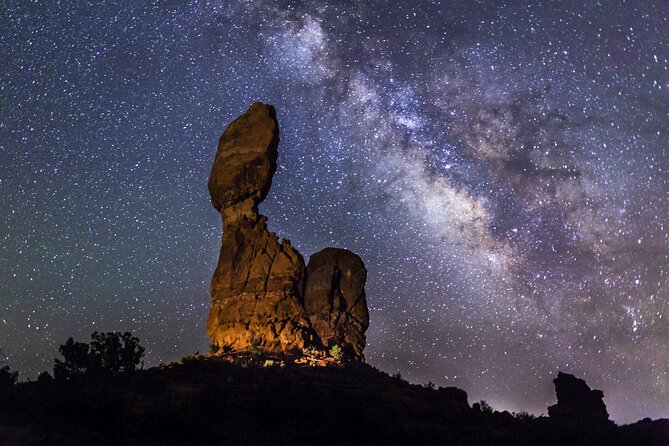
Reviewed · ARCHES NATIONAL PARK TOURS
Milky Way Photography in Arches National Park
Milky Way season turns the desert into a camera class. This Arches National Park photo tour is built around a practical crash course, then nighttime guiding so you can actually photograph the Milky Way in a dark sky park. You’ll also get a feel for how the night sky changes as you move between viewpoints inside the park.
What I like most is the hands-on camera instruction before you shoot—especially for DSLR and mirrorless cameras that can hit at least 3200 ISO. Another big win is the way the guide helps with composition, not just settings, so even first-timers can come away with usable frames. If you’re lucky enough to be guided by Colin Young or Geremy, you’ll also appreciate how patient they are when you ask questions.
One thing to think about: this is a true night tour, and the schedule can be late. In March through May, the Milky Way doesn’t show up until after midnight, so you’ll be up for a wee-hours start—and it’s not ideal if you have poor night vision.
In This Review
- Key takeaways before you go
- How the Milky Way shoot really comes together
- The camera settings lesson: what you’ll actually use
- Where you’ll shoot: Arches National Park at dark sky levels
- Timing by season: when the Milky Way shows up
- What’s included vs. what you need to bring
- Transportation and the Moab Information Center meeting point
- Cell phones and beginners: yes, you can still enjoy it
- Price and value: is $275 a fair trade?
- Who should book this Milky Way tour
- Should you book it or not?
- FAQ
- FAQ
- What’s the main focus of this Arches Milky Way photo tour?
- How long is the tour?
- Do I need to bring my own camera and lens?
- Is a tripod required?
- Is pickup available from Moab?
- How many people are in each group?
- When does the Milky Way show up on this tour?
- Is there a refund if I cancel?
Key takeaways before you go
- Real camera coaching for DSLR or mirrorless, including the settings you’ll need for Milky Way shots
- At least two locations in Arches for variety in framing and night-sky conditions
- Small group size (up to 4), which makes it easier to get help dialing things in
- Gear-focused checklist: ISO 3200+, wide-angle lens, tripod, and a headlamp (red setting is best)
- Seasonal timing matters: March–May can mean after-midnight viewing
- No camera required to enjoy it if you’re okay with learning through the experience (cell phones can help too)
More ways through Arches, gate to gate
- Arches National Park 4×4 Adventure from Moab★ 5.0 · 2,014 reviews
- Arches National Park Back Country Adventure from Moab★ 5.0 · 633 reviews
- HIGHLY RATED Arches National Park Sightseeing Tour From Moab Utah★ 5.0 · 474 reviews
- From Moab: Half-Day Arches National Park 4×4 Driving Tour★ 4.8 · 440 reviews
How the Milky Way shoot really comes together
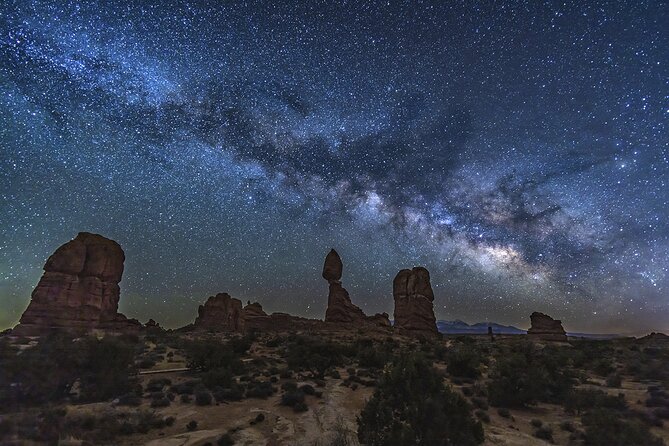
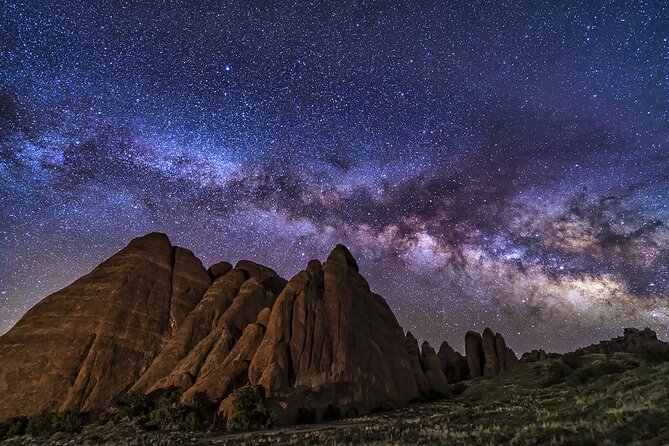
This tour is about turning a sky you can see with your eyes into images you can keep. The structure is simple: learn the basics, then go out and shoot at Arches National Park in the dark, where light pollution is low enough to make the Milky Way stand out.
Right at the start, you get instruction on how to capture the Milky Way with your DSLR or mirrorless camera. The goal isn’t technical showmanship; it’s getting you to the point where you can make a good exposure without guessing. If your camera can comfortably run around 3200 ISO, you’re already in the right ballpark for night-sky work.
Then the guide takes you to at least two spots inside Arches. That matters because the Milky Way isn’t just a single photo subject—it’s a moving composition you frame against rock, arches, and the direction of the sky. Even if you’re new, having a second location helps you try a different angle and improve your odds.
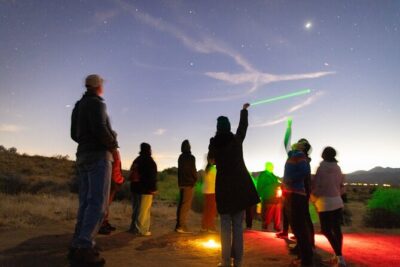
And yes, there’s a social side, even though you’re out in the dark. With a max of 4 people, it feels more like focused coaching than a rushed group activity.
The camera settings lesson: what you’ll actually use
The tour includes a mini crash course on best settings for Milky Way photography. You’re not sent out blind with a vague suggestion like point and hope. Instead, you’ll get guidance geared to night shooting on DSLRs and mirrorless.
What you should bring (this is the non-negotiable part):
- A DSLR or mirrorless camera capable of shooting at least 3200 ISO
- A wide-angle lens: roughly 14mm–35mm on full frame, or 10mm–24mm on crop
- An aperture of f/3.5 or lower (or the closest you have)
That lens guidance is a big deal. The Milky Way likes wide views because you’re capturing a large section of sky, plus some foreground for scale. If your lens is too “zoomed in,” it’s harder to fit stars and arches into one pleasing frame.
If you’ve never done night photography, I’d also expect the guide to help you get started quickly—especially with focusing tricks and getting your camera ready for low-light settings. One review mentioned Colin sending an instruction sheet before the tour, which is smart: you can arrive with your camera already partially set, saving time once you’re outside.
Where you’ll shoot: Arches National Park at dark sky levels
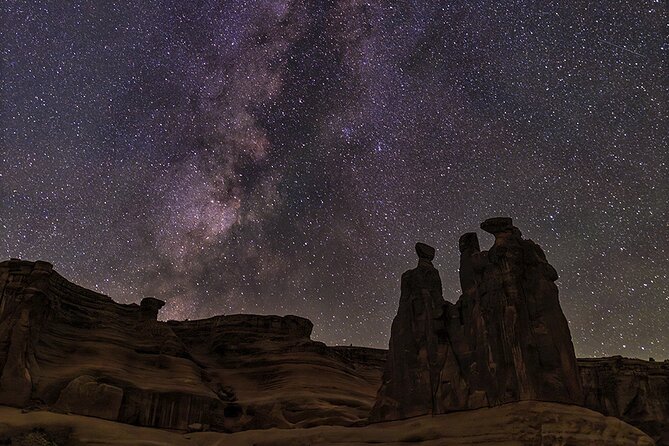
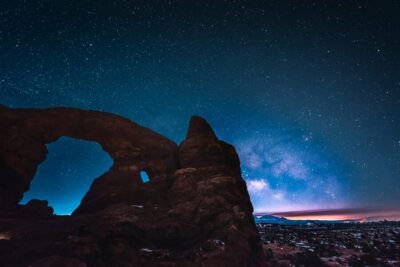
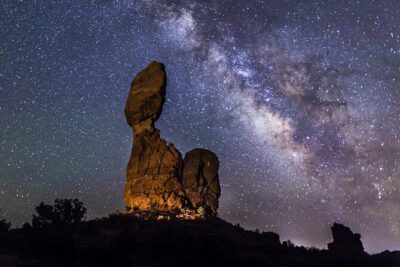
Arches National Park is famous for its arches in daylight. At night, it becomes something else. The same rock forms that guide your eye in the day can become strong foreground anchors for your photos after dark.
You’ll visit and photograph the Milky Way in at least two locations within the park. That setup is practical: different viewpoints give you different foreground shapes and different sky angles. It also helps if conditions shift slightly—cloud edges, wind, or how the night sky lines up where you stand.
The guide also brings suggestions for composition, not just exposure. That’s the difference between a technically decent star photo and one that feels intentional. You’ll hear about how to frame the sky with rock, how to think about direction, and what to watch while you’re setting up.
And don’t underestimate the storytelling element. If you’re curious about the park beyond the stars, you may get context about geology and features while you’re stopped and shooting.
Timing by season: when the Milky Way shows up
Here’s the tricky part: the Milky Way’s timing isn’t the same all year, and this tour adjusts for it.
- March through May: the Milky Way doesn’t appear until after midnight. During this period, the wee-hours Milky Way tour is offered as a standalone option, and it begins with a late night pickup.
- Fall: instead of a standalone midnight start, the offer shifts toward a combo sunset + night tour.
So when you pick your date, you’re not just choosing weather—you’re choosing the time of night you’ll be awake and shooting. If you’re the type who wants to be in bed early, plan accordingly. If you love late-night adventures and dark skies, this schedule is part of the appeal.
Also, since it’s a night activity, build in the reality that you’ll be working while it’s cold and dark. Even in months when Moab is comfortable, night photography can still make you feel chilly.
More dark-sky nights over the desert
What’s included vs. what you need to bring
This tour is organized around night shooting comfort and camera success, and you can count on a few key basics being handled.
Included:
- Snacks (with gluten-free options)
- Bottled water—you’ll be provided a cooler with ice water to refill reusable bottles
- Instruction on capturing the Milky Way with a DSLR or mirrorless camera
Not included:
- A camera. You bring your own device and lens setup.
- A spare tripod might be available to loan, but don’t plan on it as guaranteed. If you don’t have a tripod, it’s worth asking in advance.
What you must bring for best results:
- Your DSLR or mirrorless camera
- A wide-angle lens that opens to f/3.5 or lower
- A sturdy tripod (tripods are non-negotiable for Milky Way work)
- A headlamp or flashlight with a red setting (or one that you can set to red)
That red light detail isn’t just nice. It helps you preserve your night vision so you can actually see what you’re photographing and keep your eyes adapted.
Transportation and the Moab Information Center meeting point
You start at the Moab Information Center, 25 E Center St, Moab, UT 84532, and the activity ends back at the same meeting point. Pickup is offered, which matters because at night you don’t want to be navigating unfamiliar roads while also trying to set up for photography.
The tour duration is about 3 hours 30 minutes (approx.). With nighttime timing—especially in March through May—you should assume it’s a longer-feeling evening. Even if the clock says 3.5 hours, setting up, shooting, and moving between two locations takes time in the dark.
You’ll also need a moderate physical fitness level. This isn’t described as extreme hiking, but you should expect working on uneven ground at night, carrying gear, and walking carefully in the dark. Wear shoes you trust.
Cell phones and beginners: yes, you can still enjoy it
This isn’t only for people who already know photography. The tour explicitly works for group members who do not have cameras or who only have cell phones. If you want to see the Milky Way clearly in a way you probably haven’t before, this is a great introduction.
That said, the camera guidance is still geared toward serious results. For phone shooting, the note is that late model iPhones or other advanced cell phone cameras may be able to capture the Milky Way. If that’s your plan, bring your phone fully charged and be realistic about what you’ll get versus what a wide-angle camera + tripod can produce.
For beginners, the real advantage is that you’re not left to figure it out alone. You can ask questions, adjust as you learn, and get help with what to change first.
Price and value: is $275 a fair trade?
At $275 per person for about 3.5 hours, this is not a budget add-on. But it can be good value if you care about learning, not just looking.
Why it can feel worth it:
- You’re paying for instruction and on-the-spot help with settings and composition
- You get snacks and water, which is real help on a late night
- You’re in a small group (max 4), so you’re less likely to be ignored while others shoot
- The goal is a high-value experience: Milky Way photography in a known dark sky park, with multiple positions inside Arches
One practical downside to consider is that this is a small operation (one response described it as a one-person operation). Small groups can be great—more personal attention—but scheduling mishaps can also be harder to absorb. If your trip is built around this night, keep your plans flexible where possible and double-check your dates when confirmation arrives.
Who should book this Milky Way tour
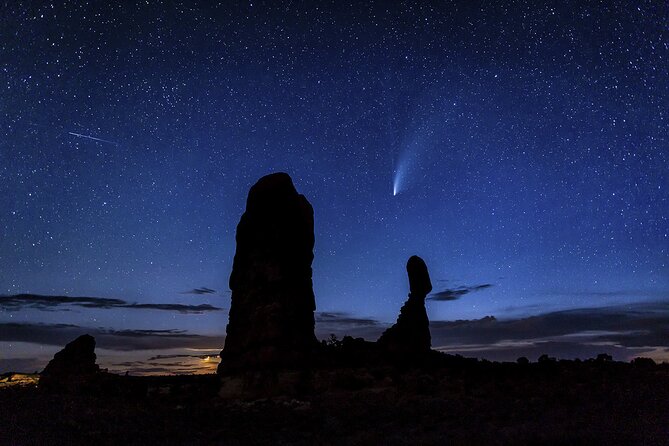
This tour fits best if you:
- Want to photograph the Milky Way and you’re bringing the right gear (especially wide-angle + tripod + ISO-capable camera)
- Are a first-timer who wants a guide to help you move from theory to real images
- Enjoy dark-sky destinations and want to experience Arches after dark, not just during the day
- Prefer a smaller group setting where questions don’t get lost
It might not fit if:
- You have poor night vision
- You want to rely only on a basic point-and-shoot (you can still enjoy it, but you may struggle with results)
- You’re not willing to handle late nights, especially in March–May when the Milky Way appears after midnight
Should you book it or not?
Book it if you want a guided, gear-informed Milky Way session at Arches, with a small group and real instruction. Bring the tripod and wide-angle lens, and you’ll be set up for a night that’s both educational and satisfying.
Skip it if your schedule can’t handle a midnight-or-late start, or if you don’t have a tripod and suitable wide-angle capability and you’re hoping for guaranteed phone-like results. In those cases, you might still appreciate the dark-sky experience, but the photography payoff may feel limited.
FAQ
FAQ
What’s the main focus of this Arches Milky Way photo tour?
The focus is learning Milky Way photography and then photographing the Milky Way at least two locations inside Arches National Park, which is recognized for dark skies.
How long is the tour?
The tour runs about 3 hours 30 minutes (approx.).
Do I need to bring my own camera and lens?
Yes. The tour does not provide cameras. You should bring a DSLR or mirrorless camera capable of shooting at least 3200 ISO, plus a wide-angle lens (14mm–35mm full frame range or 10mm–24mm crop range) that opens to f/3.5 or lower.
Is a tripod required?
Yes—a sturdy tripod is required. If you don’t have one, the operator may be able to loan a spare tripod, but it’s not guaranteed.
Is pickup available from Moab?
Pickup is offered, and the meeting point is the Moab Information Center at 25 E Center St, Moab, UT 84532. The tour ends back at that same meeting point.
How many people are in each group?
This activity has a maximum of 4 travelers.
When does the Milky Way show up on this tour?
In March through May, the Milky Way does not appear until after midnight, so the tour starts with a late night pickup. During the fall, it’s offered as a sunset + night combo rather than a standalone wee-hours shoot.
Is there a refund if I cancel?
You can cancel up to 24 hours in advance for a full refund.
More Tour Reviews in Moab
- HIGHLY RATED U-DRIVE Moab Hell’s Revenge UTV Off-Road Adventure
★ 5.0 · 3,107 reviews - Arches National Park 4×4 Adventure from Moab
★ 5.0 · 2,014 reviews - Moab: Colorado River Dinner Cruise with Music and Light Show
★ 4.5 · 1,302 reviews - You-Drive 4×4 UTV Adventure–Hell’s Revenge & Fins N’ Things, Moab
★ 5.0 · 1,114 reviews - Canyonlands National Park Half-Day Tour from Moab
★ 5.0 · 1,074 reviews
Under Moab Dark Skies
- Astro-Photo, Hiking and Stargazing Tour in Arches National Park
★ 5.0 · 63 reviews - Moab: The Windows Astro-Photography and Stargazing Hike
★ 4.8 · 36 reviews - Sunset and Night Photography in Arches National Park
★ 5.0 · 23 reviews - Professional Stargazing in Moab
★ 3.5 · 3 reviews
More Ways Into Arches
- Arches National Park 4×4 Adventure from Moab
★ 5.0 · 2,014 reviews - Arches National Park Back Country Adventure from Moab
★ 5.0 · 633 reviews - HIGHLY RATED Arches National Park Sightseeing Tour From Moab Utah
★ 5.0 · 474 reviews - From Moab: Half-Day Arches National Park 4×4 Driving Tour
★ 4.8 · 440 reviews - Discover The Best Of Moab In A Day: Arches Canyonlands Dead Horse
★ 5.0 · 327 reviews
Fresh Off the Trail: Newest Moab Reviews
- Discover Moab Rappelling on a Private Canyoneering Adventure
★ 5.0 · 3 reviews - Moab Custom 4 Seat Kawasaki KRX® 1000 Off Road UTV Rental
★ 5.0 · 3 reviews - Moab: Half-Day Rock Climbing Adventure
★ 5.0 · 3 reviews - Moab Half Day Kayaking Trip – Colorado River
★ 4.6 · 3 reviews - From Moab: Rock of Ages Moderate Rappelling Obstacle Course
★ 5.0 · 3 reviews - Professional Stargazing in Moab
★ 3.5 · 3 reviews
Arches National Park Tours, compared.
 ★ 5.0Arches National Park 4×4 Adventure from MoabFrom $1962,014 reviews
 ★ 5.0Arches National Park Back Country Adventure from MoabFrom $210633 reviews
 ★ 5.0HIGHLY RATED Arches National Park Sightseeing Tour From Moab UtahFrom $149474 reviews
 ★ 4.8From Moab: Half-Day Arches National Park 4×4 Driving TourFrom $196440 reviews
 ★ 5.0Discover The Best Of Moab In A Day: Arches Canyonlands Dead HorseFrom $399327 reviews
 ★ 4.9From Moab: Full-Day Canyonlands and Arches 4×4 Driving TourFrom $337289 reviews
 ★ 4.5Arches National Park Self-Guided Driving Audio TourFrom $16288 reviews
 ★ 5.0Arches and Canyonlands 4X4 Adventure from MoabFrom $336234 reviews
Browse the lists this tour appears in